Speaker Wiring Diagrams
for Desired Loads up to 16ohms

August 2004


PARALLEL CONFIGURATIONS


This illustrates two speakers wired in parallel.  Wired thus, the circuit load is equal to the speaker ohm divided by the number of drivers in the circuit.  In this case, 8 (ohm speaker) divided by 2 (speakers) = 4 ohm load.


This is the same as the previous diagram but with 16-ohm drivers.  16 (ohm speaker) divided by 2 (speakers) = 8 ohm load.


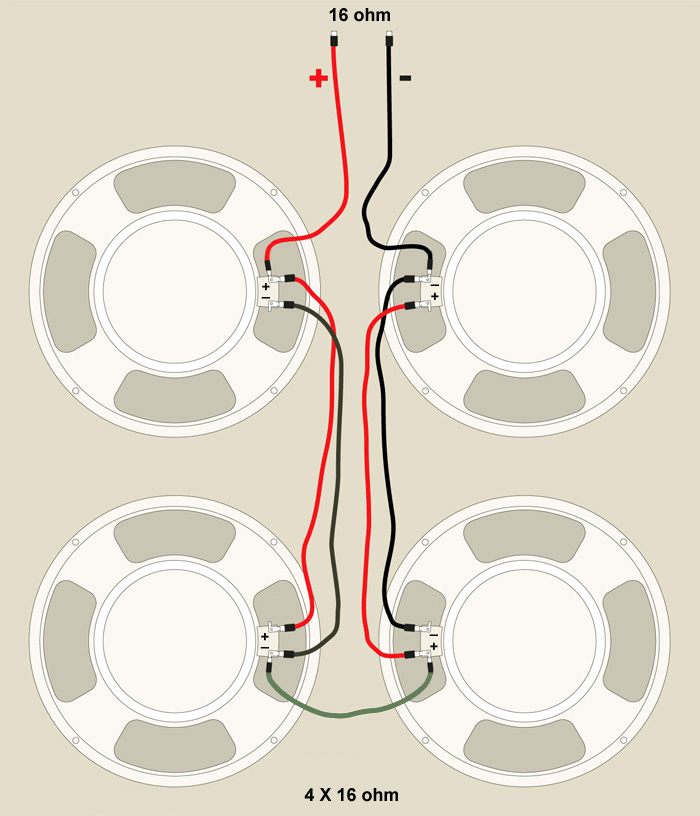
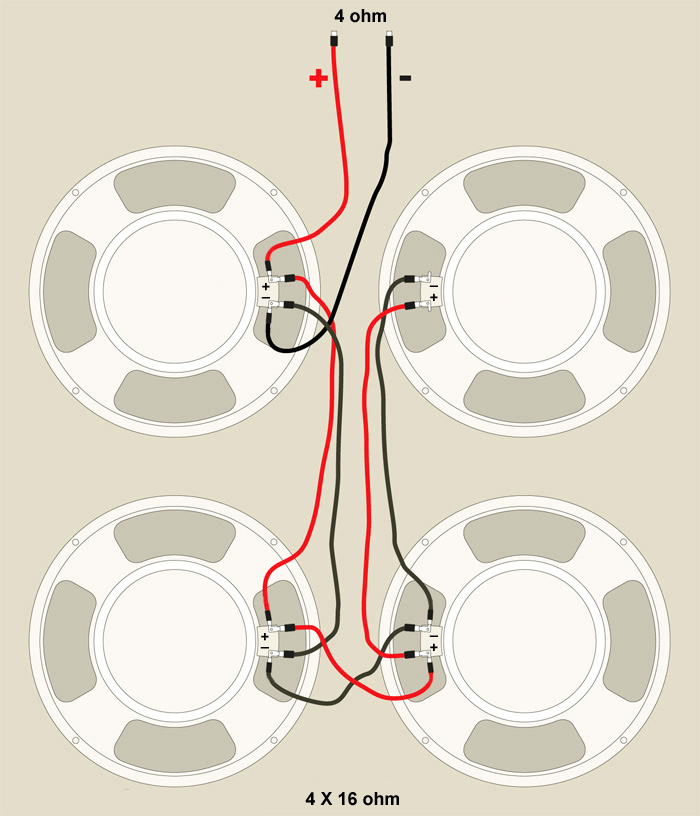
Here we have four drivers wired in parallel.  This very config can be found plugged into older Fender amps.  In this example, our resulting load is 4 ohms.  We could do the same with 8 or even 4 ohm drivers, but what would you be plugging a 2-ohm or 1-ohm cabinet into?
Here each speaker is connected directly to the pos and neg.  To beat a dead horse; 16 (ohm speaker) divided by 4 (total speakers with a direct connection to the output) = 4 ohm load.


SERIES CONFIGURATIONS


Here we have two drivers wired in series.  Wired thus, the circuit load is equal to the speaker ohm multiplied by the number of drivers in the circuit.  In this case, 4 (ohm speaker) multiplied by 2 (speakers) = 8 ohm load.


This is identical to the previous diagram, but with 8-ohm drivers.  8 (ohm speaker) multiplied by 2 (speakers) = 16 ohm load.


PARALLEL / SERIES CONFIGURATIONS

Remember, this is parallel/series, as opposed to series/parallel (which will be covered next).  All examples are with a 4-speaker cabinet.  The way we arrive at the term "parallel/series" is like this: two parallel circuits combined together in series.


In this example, picture the speakers on the left as a single two speaker circuit that is wired in parallel thus: 4 (ohm speaker) divided by 2 (speakers) = 2 ohm load.  This single 2-ohm load has a pos and neg connection.
This single load is then connected to another single load (the right two speakers) that is exactly the same.  These two 2-ohm circuits are connected in series thus: 2 (ohm load) multiplied by 2 (number of loads in circuit) = 4 ohm load.


This diagram is the same as the previous, but with 8-ohm drivers.  As above, consider each set of speakers (left; right) as their own parallel circuit, which are then connected in series.
As individual parallel circuits, they are: 8 (ohm speaker) divided by 2 (speakers) = 4 ohm load.
Now take these two 4-ohm loads and combine them in series thus: 4 (ohm load) multiplied by 2 (loads in this circuit) = 8 ohm total load.


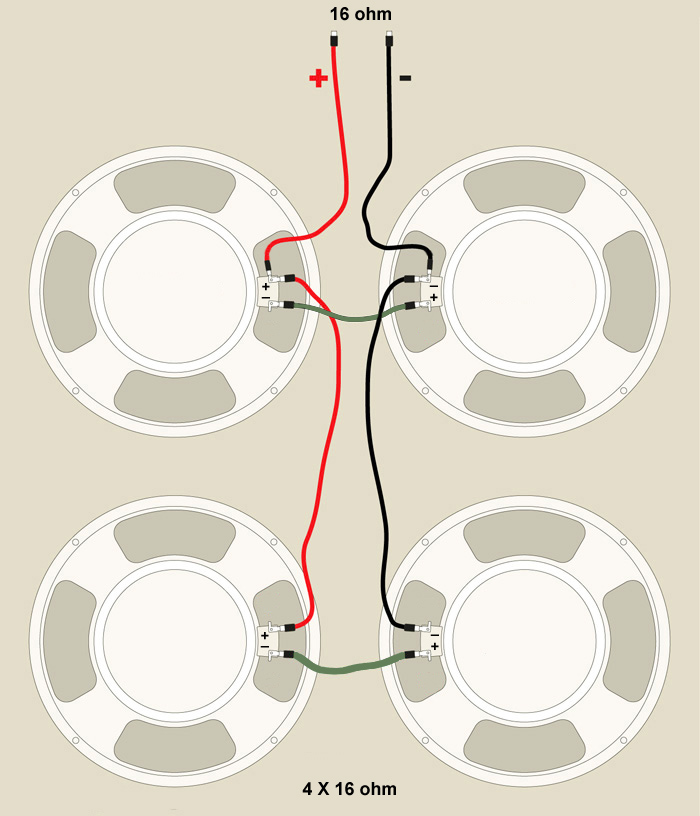
The final parallel/series diagram.  Same as previous two, but with 16-ohm drivers.


SERIES/PARALLEL CONFIGURATIONS

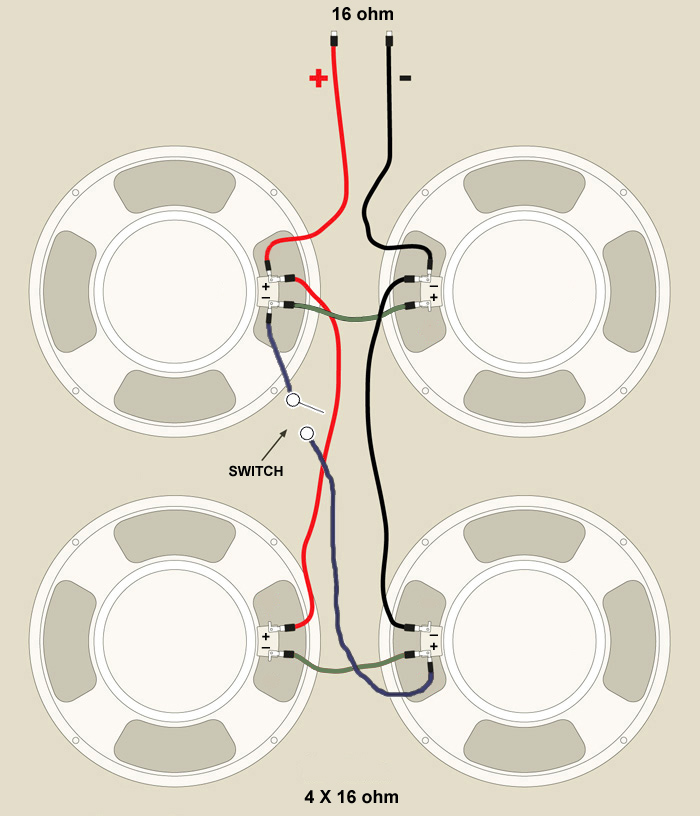
Finally, there are the series/parallel configurations.  Yes, this is really "six of one; half dozen of the other", but there are cabinets out there that are wired both ways which is why I've illustrated them both!  Looking at the diagram below, you'll notice that now there are two series speaker circuits combined together in parallel.


In this first diagram, the speakers on the left are wired in series as a single two-speaker circuit thus: 4 (ohm speaker) multiplied by 2 (speakers) = 8 ohm load.
This single load is connected to another single load (the right two speakers) that is exactly the same.  These two 8-ohm circuits are connected in parallel thus: 8 (ohm load) divided by 2 (number of loads in circuit) = 4 ohm load.


Same diagram but with 8-ohm drivers.  The formula is the same.


And finally, the same series/parallel circuit with 16-ohm drivers.


Thanks to www.amallgib.com for these diagrams!


Return to Musicain's Page